Kingdom Monera Explained: Characteristics, Structure and Examples for Biology Students
Kingdom Monera Explained: Characteristics, Structure and Examples for Biology Students


In this lesson, we have explained Kingdom Monera in a simple way that makes it easy to understand. These organisms are known as prokaryotes, meaning they have a very simple cell structure without a true nucleus.
As you go through the lesson, you will learn the main characteristics of Kingdom Monera and understand how these organisms live and function in nature. By the end of the study, you should be able to clearly describe their features and give relevant examples.
To help you test your understanding, there are 20 objective questions provided at the end of the lesson (Questions 1 to 20). Try them carefully to assess how well you have understood the topic.
Kingdom Monera (Prokaryotes)
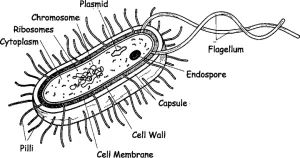
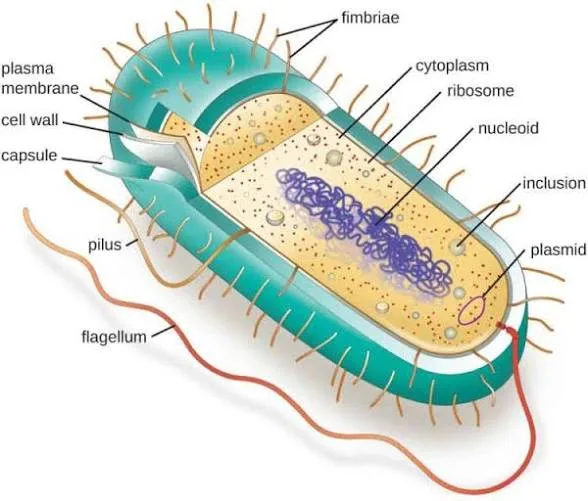
Kingdom Monera consists of the simplest living organisms. These organisms are microscopic and made up of a single cell. They are called prokaryotes because they do not have a true nucleus. Their DNA is not enclosed in a nuclear membrane but is found freely in the cytoplasm in a region known as the nucleoid.
This kingdom includes two main groups: bacteria and cyanobacteria (also known as blue-green algae). Despite their simple structure, they play very important roles in nature.
Monerans do not have membrane-bound organelles such as mitochondria or chloroplasts. However, they possess a cell membrane, cytoplasm, and ribosomes. Most of them have a cell wall, and some have an additional slimy covering called a capsule, which helps in protection and attachment to surfaces.
Some bacteria are motile and move using structures called flagella, while others are non-motile. In terms of nutrition, some are autotrophic and can produce their own food, while others are heterotrophic and depend on external sources.
Reproduction in Monera is asexual, mainly through binary fission, where one cell divides into two identical daughter cells.
Cyanobacteria are commonly found in freshwater and damp environments. They contain chlorophyll, but it is not located in chloroplasts. Instead, it is distributed within the cytoplasm. Examples include Nostoc, Oscillatoria, and Anabaena.
Bacteria are classified based on their shapes. Round bacteria are called cocci, rod-shaped ones are bacilli, spiral-shaped ones are spirilla, and comma-shaped bacteria are vibrios.
Bacteria can be both useful and harmful. They help in decomposition and soil fertility but can also cause diseases in plants, animals, and humans.
Objective Questions
-
- Which statement best describes organisms in Kingdom Monera?
A. They are multicellular with complex structures
B. They are single-celled and lack a true nucleus
C. They possess membrane-bound organelles
D. They are visible to the naked eye
- Which statement best describes organisms in Kingdom Monera?
-
- Organisms in Kingdom Monera are referred to as prokaryotes because they
A. have chloroplasts
B. lack a nuclear membrane
C. reproduce sexually
D. have complex cells
- Organisms in Kingdom Monera are referred to as prokaryotes because they
-
- The DNA of bacteria is found in the
A. nucleus
B. nucleolus
C. cytoplasm
D. mitochondrion
- The DNA of bacteria is found in the
-
- Which of the following structures is absent in bacteria?
A. Ribosomes
B. Cytoplasm
C. Mitochondria
D. Cell membrane
- Which of the following structures is absent in bacteria?
-
- The outer slimy covering found in some bacteria is called
A. cell wall
B. capsule
C. membrane
D. nucleoid
- The outer slimy covering found in some bacteria is called
-
- Movement in motile bacteria is brought about by
A. cilia
B. pseudopodia
C. flagella
D. tentacles
- Movement in motile bacteria is brought about by
-
- Binary fission in bacteria results in
A. four daughter cells
B. two identical daughter cells
C. one large cell
D. spores
- Binary fission in bacteria results in
-
- Cyanobacteria are also known as
A. red algae
B. brown algae
C. blue-green algae
D. green algae
- Cyanobacteria are also known as
-
- Chlorophyll in cyanobacteria is found in the
A. chloroplast
B. cytoplasm
C. nucleus
D. vacuole
- Chlorophyll in cyanobacteria is found in the
-
- Which of the following is an example of cyanobacteria?
A. Amoeba
B. Euglena
C. Anabaena
D. Paramecium
- Which of the following is an example of cyanobacteria?
-
- The region where bacterial DNA is located is called
A. nucleus
B. nucleoid
C. ribosome
D. vacuole
- The region where bacterial DNA is located is called
-
- Mesosomes in bacteria are mainly involved in
A. movement
B. storage
C. enzyme activities
D. digestion
- Mesosomes in bacteria are mainly involved in
-
- Cocci bacteria are
A. rod-shaped
B. spiral-shaped
C. round-shaped
D. comma-shaped
- Cocci bacteria are
-
- Bacilli are
A. spherical
B. rod-shaped
C. spiral
D. flat
- Bacilli are
-
- Spirilla are
A. round
B. rod-shaped
C. spiral-shaped
D. comma-shaped
- Spirilla are
-
- Vibrios are
A. spherical
B. rod-shaped
C. comma-shaped
D. spiral-shaped
- Vibrios are
-
- Bacteria that cannot make their own food are described as
A. autotrophic
B. heterotrophic
C. photosynthetic
D. synthetic
- Bacteria that cannot make their own food are described as
-
- One useful role of bacteria is
A. causing diseases
B. decomposition
C. destroying soil nutrients
D. preventing plant growth
- One useful role of bacteria is
-
- Cyanobacteria are mostly found in
A. dry air
B. freshwater and damp places
C. deserts only
D. deep oceans only
- Cyanobacteria are mostly found in
- Which of the following best explains why bacteria are called simple organisms?
A. They lack cytoplasm
B. They lack DNA
C. They lack a true nucleus and organelles
D. They cannot reproduce
Answers
- B
- B
- C
- C
- B
- C
- B
- C
- B
- C
- B
- C
- C
- B
- C
- C
- B
- B
- B
- C